

Find answers to commonly asked questions about the museum and the history of residential schools.
About the Museum
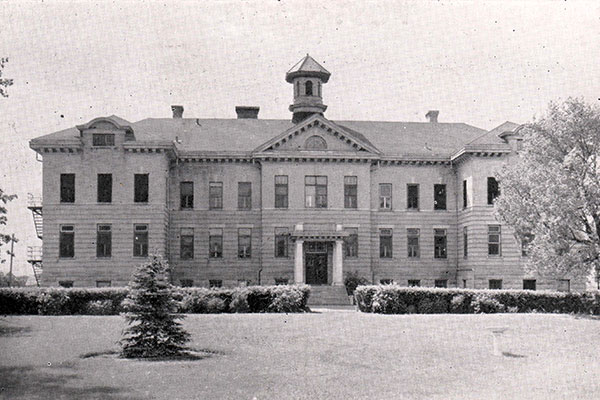
The museum is housed in the Rufus Prince Building (the former Portage Indian Residential School), one of the few remaining buildings of its kind in Canada. It is a place to learn, reflect, and honour survivors.
Rufus Prince was a former residential school student, WWII veteran, and long-time community leader. The building was renamed in his honour for his lifelong dedication to the Indigenous community.
The Assembly of First Nations supported the establishment in 2001. The museum gained charity status in 2018 and is governed by a board of former survivors.
Exhibits on Pre-Contact, Treaty Era, Residential School Era, and Contemporary Indigenous Life; artifacts, photographs, stories, and the Healing Garden with the eagle sculpture and memorial plaque.
They provide survivors and families a space for reflection, healing, and honouring those who endured or lost their lives due to the residential school system.
To educate the public, preserve history, honour survivors, support healing, and foster reconciliation.
About the Former Residential School
The Presbyterian Church (through its Women’s Foreign Missionary Society) managed the school until 1965. The United Church managed it from 1965 to 1969. All funding came from the Department of Indian Affairs.
Students came from the Long Plain First Nation, surrounding Indigenous communities, as well as northern communities. Across Canada, approximately 150,000 children attended residential schools.
Portage Indian Residential School, Portage Indian School Residence, Portage La Prairie Boarding School, and later, the Rufus Prince Building.
Students were forced to attend residential school by law (Indian Act, 1920). They were often forbidden to speak their languages, separated from their families, and pressured to assimilate into Euro-Canadian culture.
The school closed in 1975.
About the History of Residential Schools in Canada
A number of Christian denominations in Canada have issued formal apologies, statements of regret, or acknowledgements of harm related to residential schools. These responses vary in timing, scope, and language.
Churches that operated residential schools and issued apologies include:
- United Church of Canada – Apologies in 1986 and 1998 for harm caused by its residential school involvement.
- Anglican Church of Canada – Apology in 1993 acknowledging its role.
- Presbyterian Church in Canada – Apology in 1994.
- Roman Catholic Church – Apologies issued by individual dioceses and orders; Pope Francis delivered a national apology in 2022.
- Mennonite-associated organizations – Operated a small number of schools (e.g., Poplar Hill, Cristal Lake). Mennonite Church Canada has issued statements acknowledging harm.
- Baptist organizations – Operated Whitehorse Baptist (Lee Mission) school in Yukon and have issued statements acknowledging harm.
Churches not involved in operating schools but that issued statements or acknowledgements include Lutheran, Salvation Army, and other denominational bodies that recognized historical harm and committed to reconciliation.
Note: Apologies vary in scope, form, and authority. Many Indigenous communities emphasize that meaningful reconciliation requires actions beyond words, including access to records, education, and transparency.
The Royal Canadian Mounted Police (RCMP) was not created specifically to enforce residential school policies. Founded in 1873, the RCMP’s original purpose was to assert Canadian sovereignty and enforce federal law.
However, the RCMP assisted in enforcing government policy, including the compulsory attendance of Indigenous children at residential schools. This enforcement connected the RCMP to the broader system of child removal.
No. The Royal Canadian Mounted Police (RCMP) was not created specifically to enforce residential school policies. The RCMP was established in 1873 as the North-West Mounted Police to assert Canadian sovereignty and enforce federal law in the West.
However, as a federal police force, the RCMP did play a role in enforcing government policies, including those related to residential schools. This included assisting with the apprehension and return of Indigenous children who were compelled to attend, particularly after attendance became compulsory under the Indian Act.
This enforcement role connected the RCMP to the broader residential school system, even though education policy itself was administered through other federal departments.
Over time, the RCMP has taken steps to acknowledge its role and its impacts:
- Participation in reconciliation and cultural awareness initiatives.
- Public statements acknowledging harm caused by the enforcement of residential school policies.
- Commitments to education, institutional reflection, and relationship-building with Indigenous communities.
A significant step occurred in 2021, when the RCMP issued a formal, national apology acknowledging its role in enforcing residential school policies and recognizing the intergenerational trauma that resulted.
References to 2004 and 2014 generally relate to statements, expressions of regret, or acknowledgements made by RCMP representatives in specific contexts, events, or correspondence. These earlier statements recognized harm but were not issued as a single, formal, national apology on behalf of the institution.
The 2021 apology is considered distinct because it was:
Framed within Canada’s broader reconciliation efforts following the Truth and Reconciliation Commission apology acknowledging its role in enforcing residential school policies and recognizing the intergenerational trauma that resulted.
Issued at a national level by RCMP leadership.
Explicit in acknowledging the RCMP’s role in enforcing residential school policies.
A meaningful apology is more than words—it demonstrates accountability, understanding, and a commitment to change. Key elements include:
- Acknowledgment of responsibility – Clearly stating what actions or roles caused harm.
- Recognition of impact – Understanding and naming the harm experienced by survivors and communities.
- Sincerity and directness – Delivered openly, without deflection or minimization.
- Restitution and action – Commitment to education, transparency, or reparative actions to prevent repetition.
- Engagement with affected communities – Survivors and Indigenous communities guide the apology and related actions.
Many Indigenous communities note that apologies are only the first step in a long-term process of reconciliation.
Some denominations that did not operate schools issued statements recognizing the broader role of the church in colonial systems. These statements often:
- Acknowledge moral complicity in supporting government policies.
- Express solidarity with survivors.
- Commit to education, reflection, and reconciliation initiatives.
These acknowledgements show that reconciliation involves not only those directly responsible but also institutions connected to historical structures of harm.
Understanding which churches operated schools—and which did not—helps provide a full, accurate historical picture. It distinguishes institutional responsibility from broader moral accountability and helps visitors understand the complexity of reconciliation.
The National Indigenous Residential School Museum of Canada provides:
- Survivor testimony and archival records.
- Resources and publications (scholarly, fiction, and historical texts).
- Educational programming for schools, families, and international visitors.
You can also explore the National Centre for Truth and Reconciliation (NCTR) and federal records for primary sources and survivor narratives.