
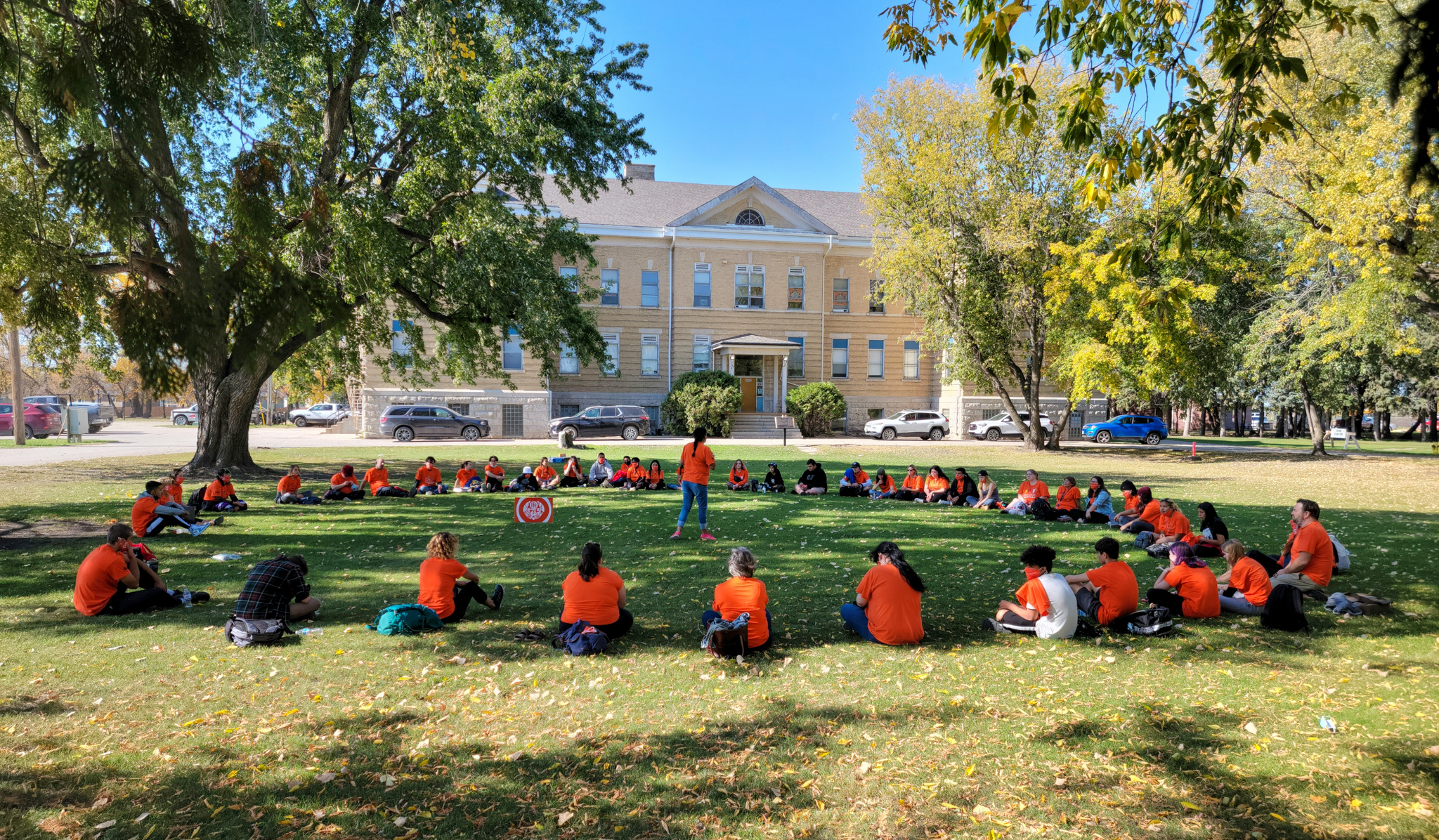


Ensuring that the history of Residential Schools is not forgotten or misunderstood.
A Place of History, Memory, and Renewal
The National Indigenous Residential School Museum of Canada (NIRSM) is located at the former Portage la Prairie Indian Residential School site in Manitoba. The building stands on the lands of Long Plain First Nation and has been transformed into a place of remembrance, education, and healing.
This site holds multiple layers of history: the original Residential School system, the transfer of land back to Indigenous stewardship, and the creation of a national museum dedicated to truth-telling and Survivors’ voices.
The Residential School at Portage la Prairie (1915–1975)
Origins and Operation
The Portage la Prairie Indian Residential School was constructed between 1914 and 1915 by the federal Department of Indian Affairs. It opened in 1915 and was operated through a partnership between church authorities and the federal government.
Over its lifetime, the school was managed by several church bodies, including:
- The Presbyterian Church (early administration, including the Women’s Foreign Missionary Society)
- The United Church of Canada (mid-century administration)
- The Department of Indian Affairs (later federal oversight)
Purpose of the School System
The school was part of Canada’s nationwide Residential School system, designed to separate Indigenous children from their families and assimilate them into Euro-Canadian society. Children were often forbidden to speak their languages or practice their cultures and were removed from their communities for long periods of time.
Students and Communities Affected
Children were taken from:
- Long Plain First Nation
- Other First Nations communities across northern Manitoba
- Inuit communities from the North
- Métis families in certain periods
The school was one of 17 Residential Schools in Manitoba and one of 164 across Canada, forming part of a system that impacted more than 150,000 First Nations, Métis, and Inuit children.
Evolution and Closure
Over time, the institution changed names and purpose:
- Converted to a student residence in 1961
- Renamed Portage Indian School Residence after major renovations in 1965
- Later referred to as the Portage la Prairie Boarding School
- Closed permanently in 1975
Land Transfer and Long Plain First Nation Stewardship
Return of the Land
In 1981, Long Plain First Nation was granted 45 acres of federal Crown land as part of Treaty Land Entitlement negotiations. This included the former Residential School building and surrounding property.
This transfer marked a significant step in reclaiming stewardship over a site that had deeply affected generations of Indigenous families.
Early Property History
- The land (Parish Lots 50, 51, and 52) was purchased by the Department of Indian Affairs in 1913
- Construction of the school followed shortly after
- In 1919, an additional 116 acres were acquired for agricultural use connected to the school system
Keeshkeemaquah Village
The site is now located within Keeshkeemaquah Village, one of three land areas belonging to Long Plain First Nation. The building and grounds are fully owned and cared for by Long Plain First Nation today.
From School to Heritage Site to Museum (1975–Present)
Post-Closure Use and Heritage Recognition
After the school closed in 1975, the building remained a significant historical structure.
- In 2005, it was designated a Provincial Heritage Site, recognizing its historical importance in Manitoba’s history
- The building remains one of the most intact Residential School structures in the province
Early Vision for a Museum (2001)
In 2001, the Assembly of First Nations passed Resolution 34(B)/2001, calling for the establishment of a national museum at the former Portage Indian Residential School site. This resolution recognized the importance of preserving the site as a place of truth, memory, and education.
This vision was later supported through Band Council Resolution and ongoing community leadership.
Establishment of the Museum
In 2018, the National Indigenous Residential School Museum of Canada was formally established as a registered non-profit organization with charitable status. It is governed by a Board of Directors made up primarily of Residential School Survivors.
The Museum continues to evolve as a national site of learning and remembrance, with a long-term vision that includes:
- Expanded exhibits and interpretive spaces
- Archival and preservation facilities
- Educational programming
- A library and research space
- A cultural and gathering centre
Purpose and Vision of the Museum
Why the Museum Exists
The Museum was created to ensure that the history of Residential Schools is not forgotten or misunderstood. It provides a space where Survivors’ voices are centred and where the public can learn directly from lived experience.
The Museum is dedicated to:
- Honouring Survivors and children who never returned home
- Preserving truth through documentation, artifacts, and storytelling
- Educating the public about the Residential School system and its impacts
- Supporting healing for individuals, families, and communities
- Celebrating Indigenous cultures, languages, and resilience
A Living Place of Education and Reflection
The Museum is not only a place of history—it is a living space where past, present, and future come together. It invites all visitors into a shared responsibility of remembering, learning, and moving forward in a good way.